

The Dragonet Prophecy — Wings of Fire — Book Review
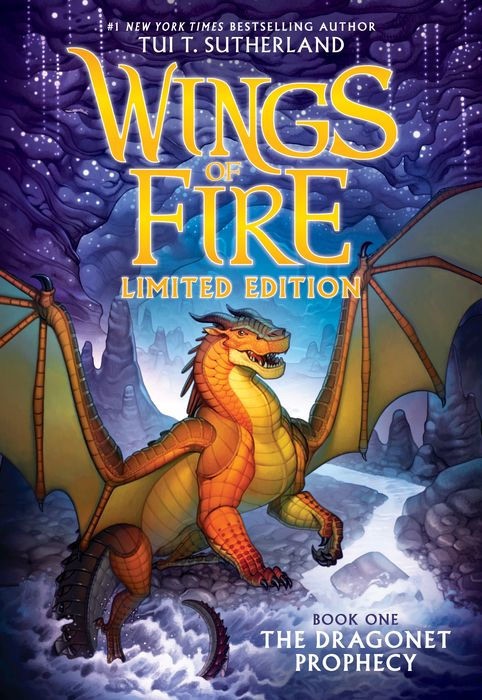
Wings of Fire does childhood trauma really well. The Dragonet Prophecy, is the first book in the 15 book series.
Finished January 8th, 2026
Wings of Fire by Tui T. Sutherland is a middle grade epic fantasy series which centers around a different dragonet (a young dragon) in each book. The Dragonet Prophecy, is the first book in the 15 book series.
The 16th, titled The Hybrid Prince, is coming out in March of 2026.
The Dragonet Prophecy kicks off the Dragonet Prophecy arc (I know, clearly very complicated from the get go). The prophecy foretells that 5 dragonets are destined to end a 20 year long war over SandWing succession. To do this, they must choose the new queen: Burn, Blister, Blaze… or perhaps, another?
The Dragonet Prophecy:
Find the SeaWing egg of deepest blue,
Wings of night shall come to you.
The largest egg in mountain high,
will give to you the wings of sky.
For wings of earth, search through the mud
for an egg the color of dragon blood.
And hidden alone from the rival queens,
the SandWing egg awaits unseen.Of three queens who blister and blaze and burn,
two shall die and one shall learn
if she bows to a fate that is stronger and higher,
she’ll have the power of wings of fire.Five eggs to hatch on brightest night,
five dragons born to end the fight.
Darkness will rise to bring the light.
The dragonets are coming …
The Talons of Peace, an underground organization, gathered 5 dragonets all born on the brightest night in the locations specified in the prophecy.
Each of the dragonets has a heartwarming coming of age tale, with a lot of development. Along the way, young readers are taught life lessons alongside them. Though, the series does have a fair bit of violence and some dark themes that are quite daring.
The Dragonet Prophecy and the subsequent books of the next two arcs take place on Pyrrhia. The shape of the landmass is adorable, like a dragon that’s loafing.
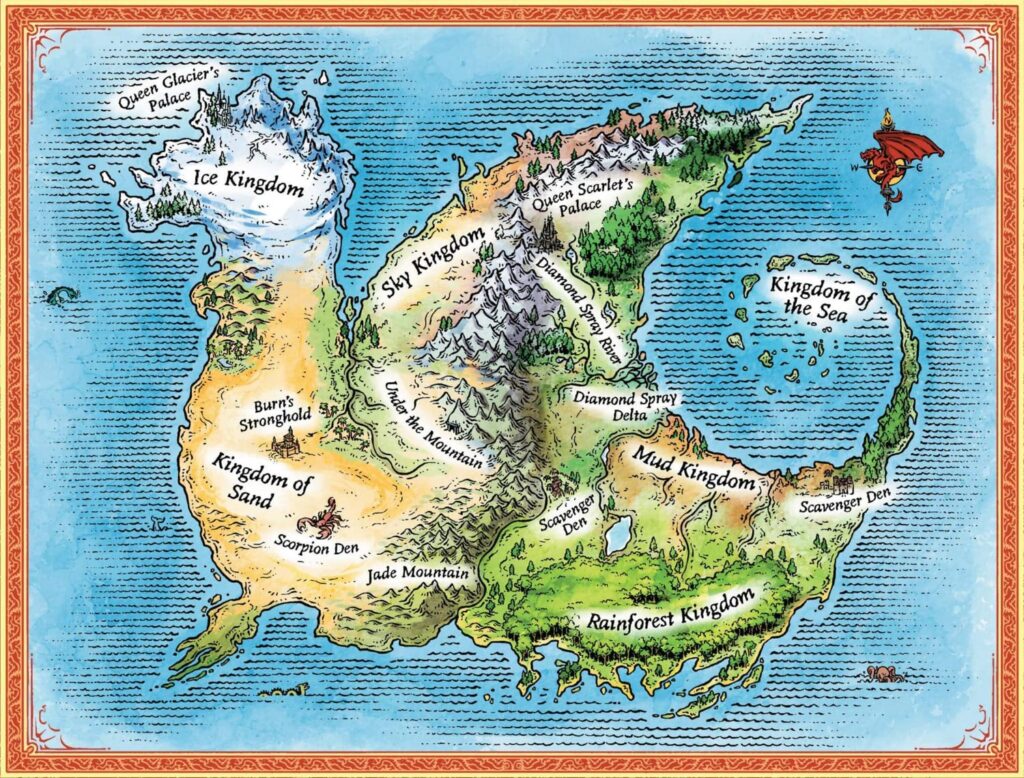
There are many types of dragons on Pyrrhia and through the course of the series, the reader becomes acquainted with each type.
I will now be spoiling the rest of the novel, so you are warned.
In the prologue of The Dragonet Prophecy, the SkyWing egg was broken by Burn, who is currently working for the main antagonist: Queen Scarlet, a SkyWing.
But, without the SkyWing born on the Brightest Night—How could the prophecy be fulfilled now?
This may be middle grade, but it does not pull any punches when it comes to violence. It is honestly one of the things I love about it. You don’t have to be a kid to enjoy it or to think the stakes are high. I was shocked reading the prologue how it goes balls to the wall right out the gate. The Dragonet Prophecy creates a sense of intrigue in the story that is unmatched.
“You wouldn’t,” he said. “No one would harm a dragon egg.” His blue eyes were fixed desperately on her talons.
“No ‘wings of sky’ to help save the world,” Burn said. “What a sad, sad story.” She began tossing the egg from one front claw to the other. “I guess that means you should be very, very careful with this terribly important little — oops!”
With an exaggerated lunge, Burn pretended the wet egg was slipping through her talons … and then she let it fall over the side of the cliff into the rocky darkness below.
“No!” Hvitur shrieked. He threw off the two soldiers and flung himself toward the edge. Burn slammed her massive claws down on his neck.
“So much for destiny,” she smirked. “So much for your tragic little movement.” (Prologue)
So, this book starts with baby murder. Which was a very good way of setting the tone for the rest of the novel.
However, destroying the SkyWing egg allows another type of dragon to be shoved into the group in order to “fulfill” the prophecy. This makes for an interesting take on the concept of prophetic destiny and allows the prologue to do double duty by introducing the RainWing racism.
Yes, this series tries to tackle themes of racism as well.
“I’ll find us a fifth dragonet.” Webs pushed past her, scales scraping against rock.
“There’s no way back into the Sky Kingdom, brainless,” she said. “They’ll be guarding the hatchery closely now.”
“Then I’ll get an egg somewhere else,” he said grimly. “The RainWings don’t even count their eggs — I could take one from the rain forest without anyone noticing.”
“Of all the horrible ideas,” Kestrel said with a shudder. “RainWings are wretched creatures. Nothing like SkyWings.” (Prologue)
As I discussed in the pre-spoiler area, these books do contain a lot of murder and dark themes, but they tackle them in a manner which is light hearted in tone. As lighthearted as one can attempt to be.
While many POV protagonists are hard pacifists, there will be more murder in this story. The stakes are of epic scale. Wings of Fire has intrigue, gore, violence, and most importantly of all: heart.
The Dragonet Prophecy‘s heart lies within its main characters, who are:
Clay, our POV, is a Mugwing. He is a big brown dragon immune to fire whose tribe comes from the marshy swamplands. He likes the feeling of wet earth under his talons, but most of all: food. Clay struggles with a preconceived notion that he is a violent monster. The Dragonet Prophecy is his book, so we’ll discuss more about him later.
Tsunami is a SeaWing. She looks like a sea serpent and loves to swim. Naturally, her tribe lives underwater. She feels the need to control everything and everyone, yet she is brash and acts without thinking. Tsunami is the group’s big sister and thinks she knows what’s best for everyone. She has an elevated sense of self that clouds her judgement. Her story is The Lost Heir, book 2.
Glory is a RainWing. Her tribe comes from the rainforest and they can change their scale color like chameleons. She has been verbally abused by everyone around her because of her tribal descent, calling her lazy and stupid. Glory faces racism and discrimination from even those closest to her. She was the last minute cover up for the dead SkyWing hatchling, causing her to feel unworthy and unwelcome from multiple traumatic angles. Her story is The Hidden Kingdom, book 3.
Starflight, the NightWing, is shy and bookish, nobody wants to listen to him, or shares his intense interests in scrolls. All that Starflight has learned about his tribe has come from scrolls or their teacher, Webs, such as: NightWings are very mysterious, mind-reading seers who live in an active Volcano. Starflight is held to lofty expectations by Morrowseer and can never live up to what he wants Starflight to be… because he doesn’t have any powers. His book is The Dark Secret, book 4.
Sunny is a SandWing. She loves to bathe in the afternoon sun as if she was in the deserts of her tribal lands. She was born without a barb at the end of her tail (a necessary part of SandWing anatomy and defense) and is often told she’s weird, especially by Kestrel. She is considered to be stupid and far too optimistic by the group. Nobody thinks she can be trusted with information, often left out and spoken down to by others. Her book is The Brightest Night, book 5.
The characters of the main cast can fit into the five man band structure. That being: leader, lancer, strong guy, smart guy, heart. However, each character could fulfill multiple archetypes, which is what makes their dynamic so great; their characterization is diverse and breaks archetype trends. Clay is loyal to his friends and supportive of everyone’s differences, like the heart. Yet, he’s also kinda a big jock, like the strong guy is often protrayed. He hates confrontation, loves to eat, and has big-brother-esque energy with his found family. Later in the story we learn he is also a born leader according to his tribal customs. I thought Clay was a strong character from the get go.
While living under the mountain, the dragonets of prophecy suffer an emotionally neglectful and physically abusive upbringing. They were isolated from their tribes—their culture—and don’t truly know what it’s like to be a MudWing, SeaWing, NightWing, etc.
I thought that the explorations of the dragonets’ childhood trauma was really interesting and unexpected for a middle grade series. This setup under the mountain allows readers to see their abuse firsthand.
The dragonets may have three parental figures with Kestrel, Dune, and Webs, but none of the three are great parents. The parental figures are physically, verbally, and neglectfully abusive respectively. Webs, in the eyes of the dragonets, is the most kind to them, but he is an enabler for the other two.
Web’s, also their history teacher, is responsible for their sheltered understanding of the kingdoms and their own tribes.
The dragonets’ lack of knowledge sets a lovely foundation for The Dragonet Prophecy to allow the characters and the reader to learn about the world at the same pace. It’s classic storytelling done in a manner which is cleanly plotted. The setup does not overstay its welcome and provides exactly enough exposition as it needs to.
Clay and Tsunami, who both embody the older brother and sister character archetypes, scheme to escape the abusive life they led under the mountain along with their siblings. But the catch is that they’re still too young to fulfill the prophecy—they have another year to go.
Escaping the mountain and their abusive household is a great example of the ways that the dragonets of destiny take their fate into their own hands, showcasing the novel’s theme of agency.
This all comes to a head as Tsunami is locked up when their guardians hear about the dragonets’ plan to escape. They think that if they have Tsunami, nobody could leave without her.
Morrowseer, the mysterious NightWing responsible for the Dragonet Prophecy and a main antagonist, comes to deus ex machina Starflight out of the situation. In reality, he has taken Starflight to be groomed into NightWing ideologies. The NightWings cast an inflated image of their tribe through propaganda. Though, this book only touches the surface of that rabbithole.
The NightWings were very intriguing—said to have powers of prophecy and mind-reading—and I was so enthralled every time Morrowseer was on the page. He is a fascinating villain and gets style points for his name. He is one of those characters that you’re supposed to hate but end up loving because they’re well written.
But mostly because they’re cool.
Clay goes to rescue Tsunami, and the dragonets escape by using an underground river. The planning and execution of stealth in this scene was pretty cool, and gave loch nest monster vibes as the gang pretended to be driftwood. In the process of their escape, they alert Queen Scarlet of the SkyWings and they’re taken to the SkyWing arena…. the fighting pits.
The dragons inside the pits are marked like slaves, wings clamped so they cannot fly.
“Like him, they each had thin metal clamps on the outer edge of their wings” (p. 120).
Inside, Clay sees horrors he couldn’t have seen in his worst nightmares.
“The war had slashed this kingdom with sharp talons. Clay spotted collapsed towers, scorch marks along several walls, and a ravine half full of dragon bones. Even as he watched, he saw two SkyWings carry in the corpse of a crimson dragon and dump it in the ravine. They set fire to the body and hovered for a moment over the smoke, their wings brushing against each other. Then they wheeled and flew away, leaving the body to blaze down into ashes and singed bones.” (p.121)
You think this kids book is wild? It only gets crazier from here. I was so surprised every time this novel pulled out these dark themes, but I couldn’t get enough of it. I loved the dichotomy between the characters’ optimistic worldview and the reality which surrounded them.
In the fighting pits, Clay encounters Queen Scarlet’s “creature” Peril, a SkyWing dragonet who burns everything her scales touch. A convenient opponent for Clay, who is fireproof. Peril was groomed from birth to be a killing machine for Scarlet.
A handful of chapters after the pair meet, Clay finds out that Peril is Kestrel’s daughter, the same Kestrel who abused the dragonets under the mountain. But, there wouldn’t be true payoff for that until the end of the book where mother and daughter chat.
Clay and Peril are adorable. I admire how he recognized Peril’s trauma and saw good within her. He gave her a second chance when everyone else thought she was a monster.
The theme of monstrosity is a big one for Wings of Fire, and it comes up a lot. Though, every time it does, I don’t find myself bored because each character is so compelling on their own.
Clay and Peril’s stories are meant to be connected, as Clay was told by Kestrel that he needed to become a killer for his found family to survive the war. When Clay was born, he was found “attacking” the eggs of the other dragonets, a story which was held over his head. It is through Peril, saving her and his friends, that Clay learns he can be a protector, not a violent monster.
Clay’s character development is not to be taken lightly. I found that towing the line between pacifism and violence was a fascinating topic to discuss in a children’s book. It showcases how The Dragonet Prophecy does not talk down to its readers, something more middle grade should do.
While in the fighting pits, Tsunami is put into the ring with an older SeaWing who has been tortured for weeks through dehydration, turning him mad.
“The writing SeaWing landed hard on the sands, dropped by the guards. He was twice as big as Tsunami, with talons as sharp and curved as fishhooks. Dried blood flecked his mouth as if he’d been trying to drink from his own veins. His scales were dull and crusted, and his dark green eyes were bloodshot and rolling wilding in his emaciated skull.
He looked completely insane.” (p. 219)
It’s kill or be killed.
More on Tsunami’s time in the SkyWing arena will be revealed in her book: The Lost Heir, book 2. You may think that killing a deranged, tortured dragon is already crazy enough, but it gets so much worse.
This scene was another one of those moments which just completely pulled me out of the story…. but not in a bad way. I was, again, just shocked that the novel was going there. Another example of how the story does not pull its punches and will bring in commentaries on war crimes and torture when necessary.
One of my favorite things to see in fantasy worldbuilding are the ways that the epic stakes affect daily life. The war of SandWing succession has direct influences on the livelihoods of every dragon in Pyrrhia. Cultures have shifted towards violence and many are distrustful of friend and foe. Tribal cultures are quite separate, many choosing to not engage with the others.
Glory is taken as Queen Scarlet’s pet and locked in a birdcage/tree because Scarlet hated that her color changing scales were more beautiful than hers.
Queen Scarlet mistakenly lets her racism cloud her judgement, and assumes that RainWings are harmless.
Meanwhile, Glory has been shooting venom at people the whole book to get the gang out of sticky situations. RainWings have a special type of deadly venom they can shoot. They’re like poison dart frogs, chameleons, and sloths all rolled into one dragon.
Glory utilizes the RainWing stereotypes others have to her advantage to skirt under the radar of antagonists’ noses—supposedly sleeping the entire time she is captive by Scarlett. Glory uses her venom on Queen Scarlet to distract from her friends in the fighting pits, melting off a side of Scarlet’s face and presumably killing her.
Due to Queen Scarlet’s vanity—she holds parties in honor of herself almost every day—her end was quite ironic and in line with her character. Scarlet’s vanity is one of the reasons I actually really like her—her end reminds me of Cersei from A Song of Ice and Fire, in that, at their lowest moment they lose the symbol of their power and vanity by a younger rival. For Cersei, it was her hair, and for Scarlet, it’s half her face!
The chaos of Scarlet’s maiming allows the dragonets of destiny to escape along with Peril. She has a new lease on life, vowing to turn to pacifism. Though, the road to improvement will be a long one for her, as her POV book, Escaping Peril, is the 8th in the series.
In a somewhat absent minded manner, Clay suggests that Peril is the prophecy’s wings of sky…. right in front of Glory, who has taken over that role in the prophecy.
Clay did not think before he spoke and ended up hurting someone close to him. He has to engage in confrontation, which he doesn’t like, but does so to mend his friend’s feelings. I think this is a wonderful lesson for young readers: think before you speak and attempt to make amends with friends.
At the end of the story, Peril and Kestrel talk about their relationship. There is a sense in this scene, that because Peril was taken from her, that is the cause of all Kestrel’s hatred and abuse of the dragonets. I did think that excusing Kestrel in this manner was not entirely sufficient, but did provide readers an explanation for why she was the way she was at the very least.
I really loved that all the dragonets had a different view of Kestrel and their upbringing: Tsunami calling abuse at one end and Sunny feeling the three tried their best on the other. In real life, kids—and adults—internalize abuse in a variety of different ways, so I think it was a wonderful addition to the story to have the dragonets to differ in this way.
Wings of Fire does childhood trauma really well—better than almost every other book series I’ve read. It doesn’t speak down to its young audience, shows them the horrors of the world, and exemplifies the good they can bring back to it through its characters’ actions.
Kids can find themselves in these dragonets and the lessons their respective struggles teach. I’m not the target audience for this book, and even I found myself related to. A story that can be enjoyed by anybody, regardless of age, is a good story.
One of the most daring lessons Wings of Fire wants its readers to learn is that one’s parents are not always the shining pillars of excellence we may uphold them to be.
As the overarching war plot unfolds, an undercurrent of small b-plots follow the dragonets finding their parents. The Dragonet Prophecy is Clay’s book, so the gang search for his parents, more specifically his mother.
Clay ends up in the MudWing kingdom, and it is here that Clay learns that his mother sold him to the Talons of Peace in exchange for a bunch of cows.
“We sold it to the Talons of Peace,” Cattail said… “Does this mean they want the cows back? Because they can’t have them. I know we were supposed to breed them, but we ate them, so too bad.” (p. 283)
Let me repeat. His mother sold him. Now, I didn’t expect that meeting his mother would go well, but I was still gobsmacked to hear that. Cattail’s usage of “it” to describe her dragonet egg was very objectifying, yet useful to convey her lack of empathy for the situation.
I was equally as concerned when I heard about the breeding parties MudWing’s have to bring new hatchlings into the world.
Breeding parties, you say? Hmmmm…… sure.
Obviously, as anyone would be, Clay is absolutely heartbroken that the figure he longed for his entire life wants nothing to do with him.
“Dragons did not cry easily, and Clay had never shed tears in his whole life, no matter how hard Kestrel had hurt him with words or claws… He realized that he was dangerously close to tears, and he could just imagine how his mother would react to that.” (p. 284)
Clay’s mom made me so angry, because how could anyone let go of their kid like that? She was more concerned about the Talons of Peace wanting their cows back than for her own son standing in front of her.
It should also be mentioned that Clay immediately goes into trauma response mode when he feels the need to convey his feelings by crying. Rather than actually cry, he forces himself to stop due to his mother laughing/lashing out at him. Kestrel really did a number on these dragonets.
With the breeding parties, we learn how it’s an aspect of MudWing culture to not be tired directly with one dragonet or another. It acts as a clear example of the important aspects of his tribal culture that Clay lacked from Webs’ teachings.
“We have breeding night once a month and then everyone goes back to their own sleephouses. No, dear, there’s no father here for you. ” (p. 285)
But it isn’t all doom and gloom for Clay, because he learns that has siblings! He has six siblings: Reed, Marsh, Crane, Pheasant, Sora, and Umber. All their stories will unfold through the rest of the series.
Umber’s book is the upcoming novel: The Hybrid Prince.
By his siblings, Clay is taught that MudWings have these things called Bigwings, the first born of the hatchlings, who will break the shells of the other dragonets’ eggs to help them hatch.
The exact thing Kestrel saw Clay doing when he was born, and assumed was a violent act. In reality it wasn’t violent, it was protective.
“His strength wasn’t for killing and violence; it was for protecting his brother and sisters. He wasn’t destined to be a monster. He wasn’t a killer deep inside somewhere.
He was a bigwings” (p. 292)
This scene with his siblings is the icing on the cake for Clay’s protector arc, as his false identity of a violent killer is dismantled once and for all. I thought it was a really beautiful end and wrapped everything up quite nicely. It also proves Kestrel was wrong about him, and probably the other dragonets too, in a satisfying manner.
Kestrel would never receive a redemption arc, as her throat is slashed and she is pushed off a cliff in the epilogue (mirroring what was done to the SkyWing egg), by the conniving SandWing, Blister, and the shadowy Morrowseer.
”Blister’s claws ripped across Kestrel’s throat before she could scream… Blister took another stepo and stabbed Kestrel in the heart with her poisonous tail” (p. 303).
In the final scene, we find out their plot to force the dragonets of destiny to choose Blister as the SandWing Queen to end the war. This brings into question everything readers knew about the Talons of Peace and the agency dragonets of destiny possess.
“Not a problem,” Blister said again. She stared out at the pounding sea below them. “What’s one more dead dragon here or there on my way to the throne?”
Morrowseer smiled. “Then we understand each other.”
“Give me the dragonets,” she said, “and we’ll both get everything we want.” (p. 304)
I love how Wings of Fire urges children to break the molds set for them by their parents and society—to be the people they want to be, not what others want them to be.
The Dragonet Prophecy is a great start to the Wings of Fire series. Its characters are well rounded, relatable, and feature excellent character development. The plots are high stakes and thrilling, as Queen Scarlet would say. Finally, it does what middle grade should, and teaches valuable lessons to young readers.
Is The Dragonet Prophecy and Wings of Fire sometimes a bit dark? Yes. But I think that’s apart of the appeal and as a result of the themes it attempts to explore. Though, it takes its readers seriously and does not speak down to them.
Whether you’re a parent looking for books for their kids, a kid yourself, or an adult looking for an exciting fantasy series, I highly recommend picking up The Dragonet Prophecy and the rest of Wings of Fire.
Rating:
To learn more about Wings of Fire, check out Tui T. Sutherland’s website!