

Here’s What I Read for My English Degree
Have you ever wondered what books English majors actually read for class?…
Have you ever wondered what books English majors actually read for class? It’s not all Shakespeare and Jane Austen.
As an English major in my final semester, I have read my fair share of books that have taken me on emotional rollercoasters, shaped my understanding of the world, or frankly, made me want to argue. Some on this list are now permanently etched into the fabric of my memory for better or worse.
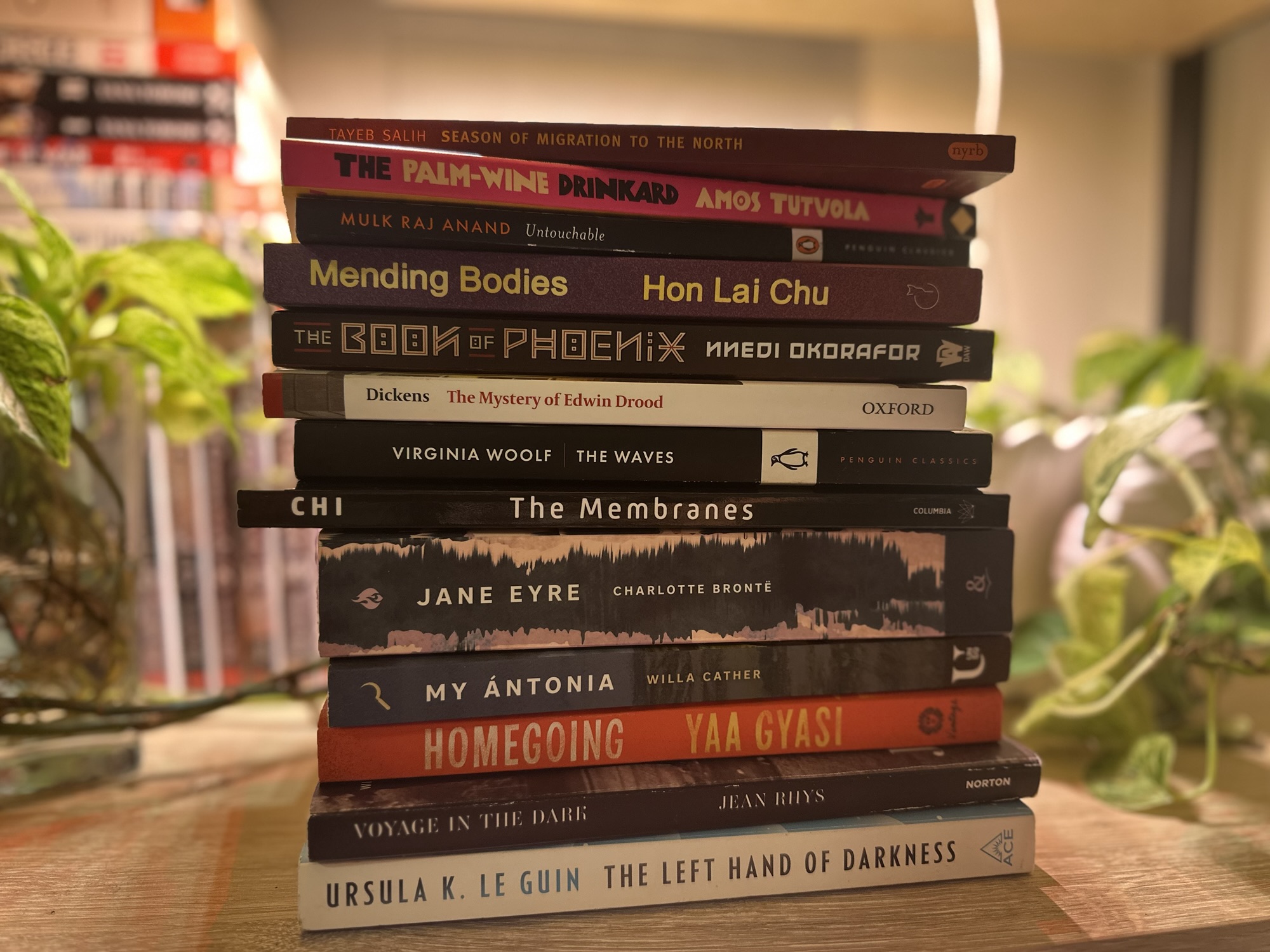
Here are 11 books I’ve read for my English degree:
- Waste Tide by Chen Qiufan
- Have you ever heard the Arthur C Clarke quote that *any sufficiently advanced technology is indistinguishable from magic*? Well this book exemplifies that quote to the letter. China is slowly rotting under a heaping garbage pile, worked by swaths of poor laborers, the waste people. Cybernetic enhancement and robotics break down the barriers of human and machine. Humanity claws towards godhood one upgrade at a time. This is the latest book I’ve read for a class and found it particularly engaging for its discussion of power, religion, capitalism, and the collapse of our climate.
- The Left Hand of Darkness by Ursula K. Le Guin
- I don’t think any of my favorite fantasy books would exist without the extraordinary influence Le Guin has had on the genre. Her anthropological background makes the world of Gethen come alive. The novel is revolutionary for its conversations of sex and gender. Genly Ai, an envoy, is sent to the planet where everyone’s sexual physiology is fluid. The nations of Gethen are locked in cold war style political espionage. Everyone has a role to play and diplomacy is emotional manipulation.
- The Divine Comedy by Dante Alighieri
- In my opinion, The Divine Comedy is the greatest piece of fan-fiction ever written, because somehow it shaped the western world’s understanding of Hell through one man’s desire to enact symbolic retribution to anyone who ever wronged him. Dante takes a spiritually retrospective nostalgia tour through the afterlife while meeting all his philosophical and literary heroes. A self insert fanfic at its finest.
- Ariel by Sylvia Plath
- Reading Sylvia Plath is like a rite of passage for the modern depressed femme. Ariel was posthumously published by Plath’s husband and is widely considered her masterpiece. It’s female rage on the cusp of mania. Her poetry truly captures the energy of wanting to throw a toaster into the bath but smudging red lipstick on your cigarette while doing so.
- Jane Eyre by Charlotte Brontë
- I’ve read Jane Eyre so many times I’ve lost count and no list of my university books would be complete without it. The book is a classic work of gothic literature which takes the form of a coming of age novel for the titular main character. Starting off as an orphaned and abused child, Jane learns to build relationships on her own terms and find a sense of belonging. I especially loved delving into discussion about the progression of Jane’s agency through the novel.
- Voyage in the Dark and Wide Sargasso Sea by Jean Rhys
- Jean Rhys is next to Sylvia Plath on the sad English major political compass, right at the intersection of “Horny” and “Hates Men.” Voyage in the Dark’s main character, Anna Morgan, participates in pseudo sex work and has a sugar daddy. Meanwhile the story takes place on the cusp of WWI, a period of time where women were expected to be doorstops. Anna spirals into self-destructive depressive mania until the intentionally ambiguous ending.
- Wide Sargasso Sea is an honorable mention for being a retelling of one of my favorite novels, Jane Eyre, from the perspective of Antoinette Cosway or Rochester’s first wife, Bertha Mason. Jean Rhys is an expert at capturing the otherness of a creole identity from personal experience.
- The Membranes by Chi Ta-Wei
- This book is a trip best taken blind and without a sitter. It’s near-future science fiction that follows the main character, Momo, a skin care tech, as she works through her bodily trauma. It’s set in an Atlantis-like city after the Earth’s ozone layer has been destroyed, frying the surface of life. This book melts your brain more than the ozone hole did the Earth. Any further description of it I fear would spoil the entire thing, so you should just trust me and go have your brain melted.
- Homegoing by Yaa Gyasi
- Homegoing is a multi-generational tale of slavery, colonization, and oppression. Homegoing hands you a family tree, scatters the members across continents, and expects you to pick up the pieces of your broken heart while it’s still smashing it to bits. The novel starts off with two sisters in Ghana, one who is sold into slavery and another who marries a white slaver. From there, we follow their descendants across vast oceans for seven generations.
- Paradise Lost by John Milton
- John Milton accidentally made Satan one of the most compelling characters in literary tradition all in an attempt to glorify God. If that isn’t the funniest twist in the literary world, then I don’t know what is. Paradise Lost is meant to be a warning against the sins of pride and greed, but inadvertently praises independence and self-discovery. Milton’s Satan is a tragic anti-hero that is oddly relatable in unintended ways.
- The Waves by Virginia Woolf
- You know when your friend group gets together and everyone shares a singular collective brain cell? Well that’s The Waves, except the brain cell is having an existential crisis. The novel is highly experimental and tries to discuss the human condition through the soliloquies of 6 friends. It’s about the passage of time, people getting old and growing apart, and what that does to one’s mind. Everything in the novel dissolves into a collective consciousness, like sea foam in ocean waves. Out of all the books I’ve included on this list, I remember finding this one the most difficult to parse through.
Have you read any of the books on this list? What are some books you read for university?
Want to start annotating like an English major? Check out how I use Obsidian here!
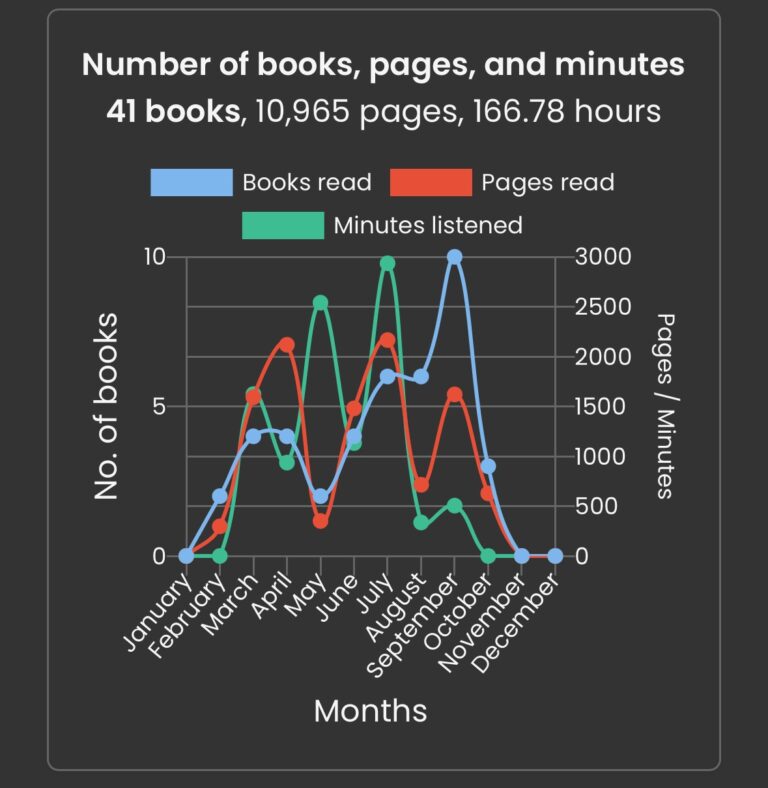
Are you reading a ton of books and don’t know how to track them? You should try out The StoryGraph. Learn more about why The StoryGraph is the best Goodreads alternative with my article.
Image Credit Kaitlyn Parker